Beginning Greek Grammar Guide
Pick up where you left off later. Your reading position and highlights save on this device.
Introduction
I regularly review beginning Greek grammars on the Biblical Mastery Academy YouTube channel.
After I review each grammar, I assign it a spot on “the leaderboard” below. This page lists the grammars I’ve reviewed, ranked in order.
For each grammar you’ll find:
- Publication information and purchase links
- Video review
- Use case
- Distinctives
- Strengths
- Weaknesses
If there is a grammar you’d like me to add to this list, let me know. There are a lot of grammars on the market and more come out every year, so I may not get to every one quickly. I tend to prioritise newer grammars over older ones.
To find out when new reviews are published, subscribe on YouTube.
Subscribe to BMA on YouTubeTop 10 countdown video
The leaderboard
Merkle and Plummer, Beginning with New Testament Greek
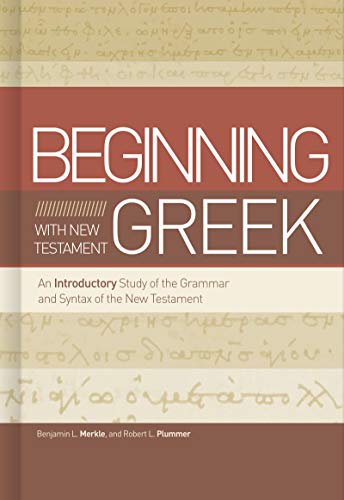
Benjamin L. Merkle and Robert L. Plummer, Beginning with New Testament Greek: An Introductory Study of the Grammar and Syntax of the New Testament (Nashville: B&H Academic, 2020), 281 pages.
Video review
Use case
Best all-round grammar, ideal for self-study, but also great as a classroom grammar or to help refresh.
Distinctives
Very good balance of pedagogy and quantity of content, includes exercises and answer key, lots of free resources available online.
Strengths
- Strong morphology and guidance
- Streamlined approach
- Good treatment of liquid verbs
- Clear guidance for what to memorise
- Built-in workbook with several types of exercises
- Lots of online resources available
Weaknesses
- Possibly introduces too many exegetical categories
- Minor: holds to 3-aspect view of verbs
- Minor: uses helper verbs for present tense form translation
Pair with: Mounce for more detail and morphology. Mounce is referred to frequently in this grammar.
Harris, An Introduction to Biblical Greek Grammar
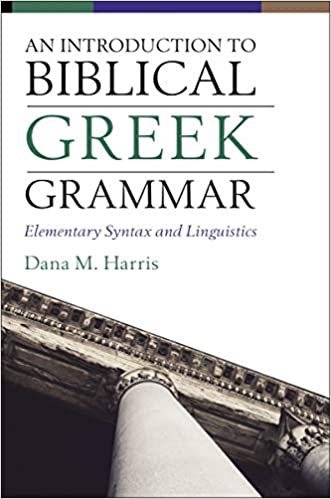
Dana Harris, An Introduction to Biblical Greek Grammar: Elementary Syntax and Linguistics (Grand Rapids: Zondervan Academic, 2020), 471 pages.
Video review
Use case
Classroom grammar, reference grammar.
Distinctives
A strongly aspectual understanding of verbs, larger vocabulary than the average grammar, and excellent explanations throughout.
Strengths
- Best-in-class discussion of morphology
- Excellent explanations of English grammar help with learning Greek
- Consolidated paradigms
- Clear guidance on what needs to be learned
- Helpful summaries
- Revisits concepts, expanding on them later
Weaknesses
- Some chapters are a little overwhelming for students
- Verbal aspect seems confused with aktionsart
- Doesn't mention liquid aorists (but covers liquid futures well)
- Still refers to deponency
- Requires an additional purchase for exercises, making this an expensive option
Pair with: Decker for different explanations, or perhaps with Mounce or Schwandt for additional morphology.
Decker, Reading Koine Greek
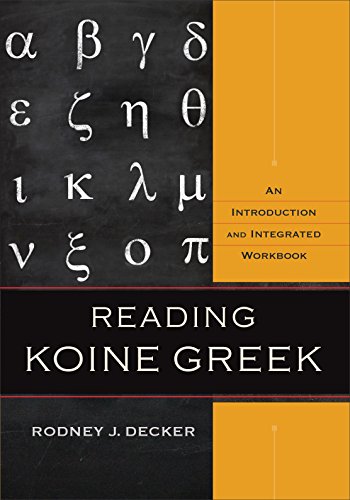
Rodney J. Decker, Reading Koine Greek: An Introduction and Integrated Workbook (Grand Rapids: Baker Academic, 2014), 564 pages.
Video review
Use case
Great for self-study or classroom use. Also an ideal reference grammar or for reviving your Greek. Intended to be used into second-year and exegesis classes.
Distinctives
Very thorough, great treatment of verbs, outstanding descriptions and explanations, revisits previous concepts, deepening knowledge without overwhelming.
Strengths
- Best-in-class treatment of verbs
- Up-to-date and linguistically based understanding of verbs
- Revisits concepts, building them out
- Excellent relation to English grammar
- Built-in workbook with several types of exercises
- Provides larger vocabulary and uses broader texts in exercises
Weaknesses
- Minor: holds to 3-aspect view of verbs
- Minor: uses helper verbs for present tense form translation
- Content may be overwhelming for some first-time learners
Pair with: Croy for simplified explanations, or with Mounce's Basics of Biblical Greek for more on morphology.
Dobson, Learn New Testament Greek
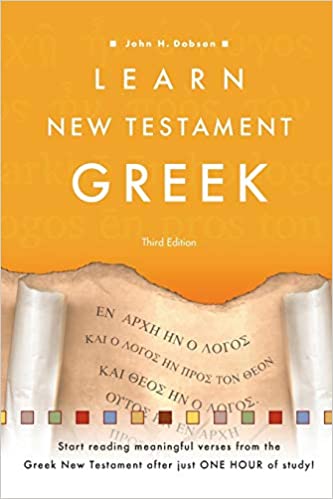
John H. Dobson, Learn New Testament Greek (Grand Rapids: Baker Academic, 2005), 333 pages.
Video review
Use case
Designed for and ideal for self-study.
Distinctives
Very different approach to learning the language, almost eliminating memory work and paradigms, delaying grammatical instruction until much later in the student's study. Moves quickly and is intended to help keep students moving.
Strengths
- Focused on reading and reinforcement through repetition
- Eliminates technical grammar discussion
- Minimal memory work
- Short, simple exercises
- Learn by doing
Weaknesses
- Weak indexing
- No discussion of verbal aspect; holds to time in the indicative
- Minimal vocabulary or guidance for vocabulary acquisition
- Delayed grammar may lose students prematurely
Mounce, Basics of Biblical Greek
William D. Mounce, Basics of Biblical Greek (Grand Rapids: Zondervan Academic, 2019), 415 pages.
Video review
Use case
Ideal as a classroom grammar, but great for reviving Greek or as a reference grammar.
Distinctives
Mounce's grammar is strong in morphology, clear on what the student needs to learn, and provides two learning paths for professors.
Strengths
- Best-in-class discussion of morphology
- Excellent explanations of English grammar help with learning Greek
- Consolidated paradigms
- Clear guidance on what needs to be learned
- Helpful summaries
- Revisits concepts, expanding on them later
Weaknesses
- Some chapters are a little overwhelming for students
- Verbal aspect seems confused with aktionsart
- Could provide more coverage of liquid aorists (but covers liquid futures well)
- Still refers to deponency, even in the 4th edition
- Most expensive grammar (if you buy the workbook too)
Pair with: Beginning with New Testament Greek (Merkle and Plummer) for clear explanations, or Reading Koine Greek (Decker) for more detail and a better approach to verbs.
Gibson and Campbell, Reading Biblical Greek
Richard J. Gibson and Constantine R. Campbell, Reading Biblical Greek (Grand Rapids: Zondervan, 2017), 125 pages.
Video review
Use case
Designed almost exclusively for classroom work.
Distinctives
Keeps concepts small, but depends on group interaction. Aspectually very good, but not ideal for self-study.
Strengths
- Designed to have students work through the Gospel of Mark with some fluency
- Aspect is treated very well
- Minimal memory work
- Short, simple exercises
- Learn by doing
Weaknesses
- Vocabulary is focused around the Gospel of Mark, so it may skip words that occur regularly elsewhere
- Depends on instructor, so it requires preparation to teach through and could benefit from more guidance or a fuller teachers' guide
Zacharias, Biblical Greek Made Simple
Danny Zacharias, Biblical Greek Made Simple (Bellingham, WA: Lexham Press, 2018), 284 pages.
Video review
Use case
Classroom or self-study (see distinctives).
Distinctives
Designed to be completed in a single semester, with the option of a second semester. Lower vocabulary requirements, reflecting a less burdensome outcome for the student.
Strengths
- Very good descriptions and explanations
- Excellent formatting and use of colour
- Helpful 'the least you need to know' sections at the end of each chapter
- Fully embraces technology, and includes video links
- Learn Logos at the same time as Greek
Weaknesses
- Very dense information, and significant per-chapter homework requirements (offset by the 'least you need to know' sections)
- Could do with more interaction with how English works to clarify how Greek is similar or different
Pair with: Reading Koine Greek (Decker) for more detailed explanations. Decker has much the same approach to verbs.
Croy, A Primer of Biblical Greek
N. Clayton Croy, A Primer of Biblical Greek (Grand Rapids: Eerdmans, 1999), 203 pages.
Video review
Use case
Classroom grammar.
Distinctives
Well-written grammar with lots of exercises, organised to introduce quite a few concepts in the early chapters to expand exercise options. Dated.
Strengths
- Very good descriptions and explanations
- Lots of exercises drawn from the NT and LXX as well as author-created
Weaknesses
- Dated — teaches deponency and largely doesn't deal with verbal aspect at all
- No answer key for exercises
- Quirk: emphasises inclusive language
Pair with: The 4th edition Mounce's Basics of Biblical Greek for explanations, and a slight update to deponency and verbs.
Schwandt, An Introduction to Biblical Greek
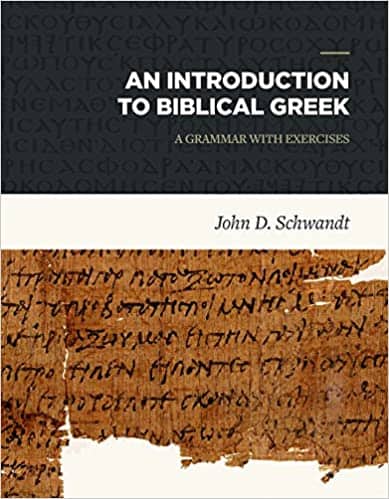
John D. Schwandt, An Introduction to Biblical Greek: A Grammar with Exercises, revised ed. (Bellingham, WA: Lexham Press, 2020).
Video review
Use case
Reviving Greek or possibly solo learning.
Distinctives
A rewrite of Nunn's 1913 grammar that provides significant updates while also retaining Nunn's classical approach to learning through translating from English to Greek, focusing on accents and understanding morphology.
Strengths
- Excellent discussion of morphology
- Excellent formatting and use of colour
- Helpful 'the least you need to know' sections at the end of each chapter
- Built-in workbook with excellent variety of exercises to help students learn
- Includes answer key
- Difficult subjects are introduced gradually
Weaknesses
- Participles in one chapter may be a little brief for this difficult component of biblical Greek
- Holds to time in the indicative mood
- Light discussion of moods
- Treats cases in a different order to most grammars
Pair with: Croy for simplified explanations using the same approach to deponency and verbs. Decker is a good foil for these against Schwandt.
Black, Learn to Read New Testament Greek
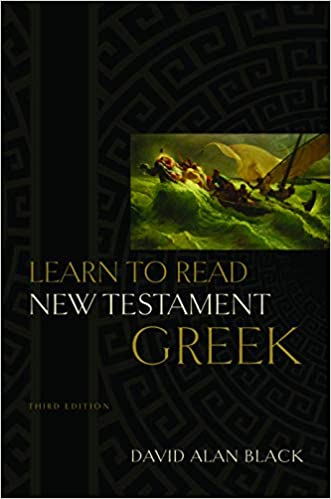
David Alan Black, Learn to Read New Testament Greek (Grand Rapids: Baker Academic, 2009), 215 pages.
Video review
Use case
Classroom grammar.
Distinctives
A popular, linguistically oriented grammar that presents well. A little dated now, but still holds up in the classroom.
Strengths
- Strong exercises, including English to Greek
- Doesn't focus on extraneous grammatical concepts
Weaknesses
- Dated: teaches deponency
- Some chapters might be overwhelming to students
- Doesn't provide enough guidance for what students should learn
Pair with: Mounce for morphological explanations and more detail. Mounce's 4th edition also updates verbs and the middle voice.
Summers, Essentials of New Testament Greek (Revised Edition)
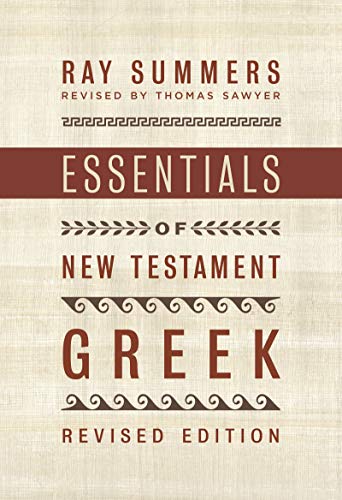
Ray Summers, Essentials of New Testament Greek, revised ed. (Nashville: B&H Academic, 2019), 156 pages.
Video review
Use case
Classroom grammar.
Distinctives
Very brief — perhaps the least expensive beginning Greek grammar being commercially published today.
Strengths
- Clear descriptions
- Short chapters
- Great approach to third declension
- Exercises at the end of each chapter (workbook included)
- Order of content leaves more difficult concepts until the end
Weaknesses
- No answer key and no additional content
- Syntactically dated (teaches 8 cases)
- Often over-emphasises meaning over form
Pair with: A more comprehensive grammar (e.g. Decker or Mounce). Decker might be too much of an update. You might wonder why you'd teach using this.